
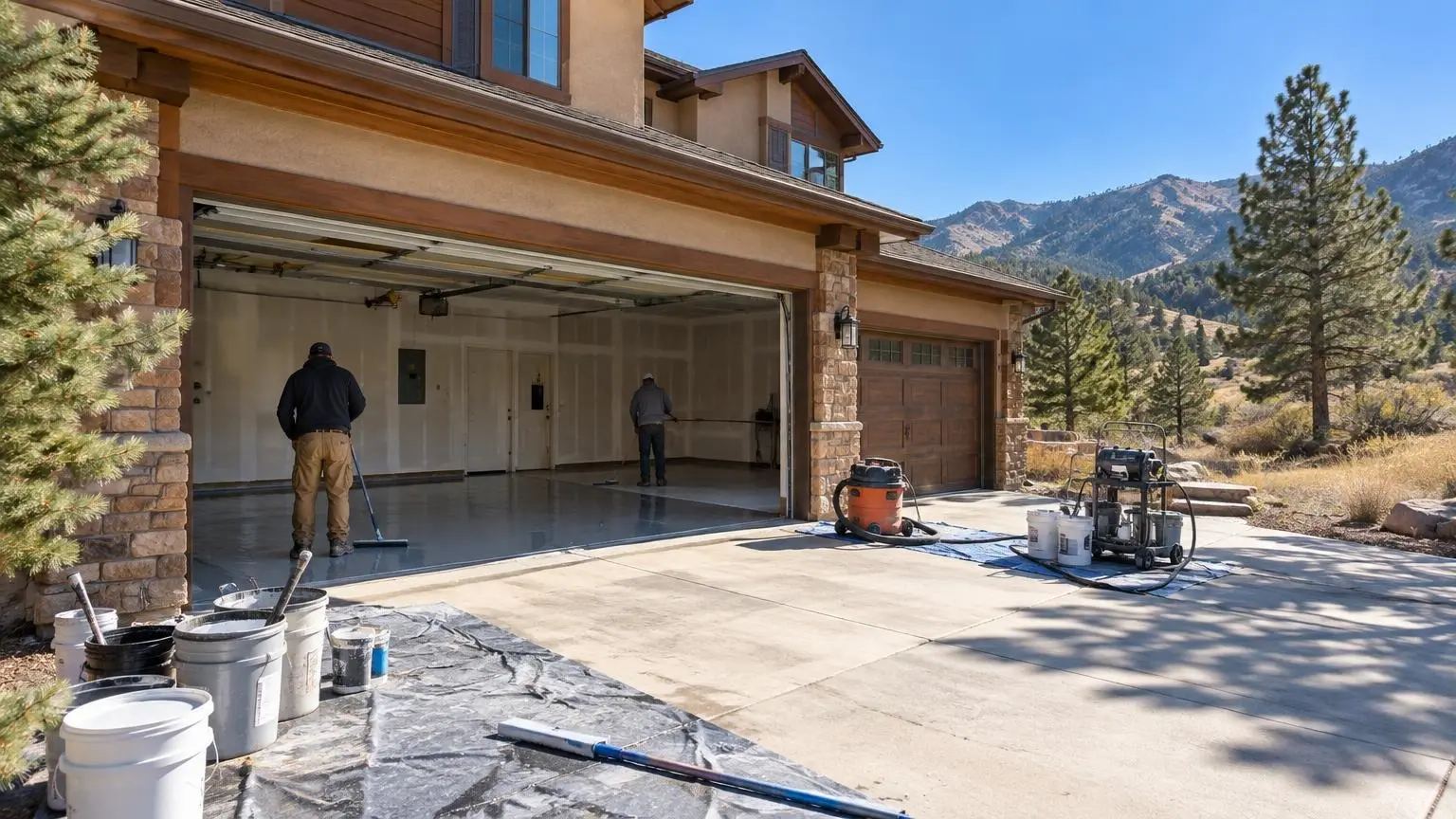
Garage, basement & shop floors
Epoxy Flooring in Boulder, CO
Floors built for de-icer, hot tires and high-altitude sun, installed on a properly prepared slab.
- Free on-site estimates
- Slab moisture-tested before we coat
- Written quote before work starts
A Garage Floor Built for the Front Range
Epoxy flooring in Boulder has to handle a harder mix of conditions than most places. Boulder averages about 90 inches of snow a season (89.71 inches over the 1991 to 2020 period, by NOAA's count at the NIST site), and the frost season commonly runs from early October into early May. Between storms, chinook winds and bright sun can swing a garage from frozen to mild and back again. A coating here has to be tough, flexible and stable in strong sunlight.
What winter drags into the garage
Colorado's highway department uses liquid magnesium chloride among its de-icers. It works well on roads, but it rides into the garage on every tire and wheel well, and research done for state transportation departments has found concentrated magnesium chloride can chemically attack concrete. Left on a bare slab, it dries, soaks back in with the next storm and slowly pits and scales the surface, starting by the door. A sealed, coated floor keeps that brine on top, where a squeegee or hose can clear it.
Sun at 5,430 feet
UV gets stronger as you go up; the EPA puts the increase at about 2% for every 1,000 feet. At Boulder's elevation, a garage door left open on a summer afternoon puts real sunlight on the floor, and ordinary epoxy topcoats can turn amber under it. That is why we recommend finishing most garage floors here with a UV-stable polyaspartic topcoat.
Slabs that move
The Colorado Geological Survey calls expansive, swelling clay the state's most significant geologic hazard and notes that cracked and heaved garage and basement floor slabs are very common. Most of that cracking is cosmetic and can be repaired before coating. A slab that is still actively heaving is a different problem, and we tell you plainly when a floor needs an engineer or concrete contractor before it needs a coating.
Why prep decides how long a floor lasts
Most failed garage floors were not bad products. They were good products put on a slab that was not ready. Smooth, sealed or dusty concrete gives a coating nothing to grip, and moisture rising through the slab pushes it off from underneath. Every floor we coat is diamond-ground first, cracks and pits are filled and ground flush, and the slab is tested for moisture before anything is mixed.
Which coating fits your floor
There is no single best floor coating. A two-car garage that sees daily winter driving is usually best served by a full-broadcast flake system with a polyaspartic topcoat: it hides imperfections, adds grip and handles hot tires. A finished basement or a lightly used garage may suit metallic epoxy. A workshop that takes dropped tools and rolling jacks needs a thicker build. The estimate visit is where we sort that out with you, standing on the floor.
What the estimate visit covers
We measure the space, note the condition of the slab and any old coating, look for signs of movement, test for moisture, and ask how you use the room: daily parking, a workshop, ski and bike storage, a home gym or a finished basement. Then we recommend a system, show flake or metallic samples in your own light, and leave a written quote. If the slab has a problem a coating cannot fix, we say so instead of selling you a floor that will fail.
Caring for a coated floor
Coated floors are low maintenance, but a few habits add years. In winter, squeegee or rinse de-icer meltwater off the floor instead of letting it dry in puddles. Use a soft-bristle broom and a mild cleaner, not acids or citrus degreasers. Put a pad under kickstands, jack stands and ski racks with sharp feet. If the floor gets a chip, have it patched before brine works under the edge.
Our Epoxy Flooring Services
Six services cover almost every garage, basement, shop and commercial floor in the area. Each one starts with the same grinding and repair prep.
Garage Floor Epoxy
Full-broadcast flake systems built for mag chloride, hot tires and daily parking.
Learn more →Polyaspartic Floor Coating
Fast-curing, UV-stable coatings that handle high-altitude sun and big temperature swings.
Learn more →Metallic Epoxy Floors
Poured, marbled finishes for basements, home gyms and finished spaces.
Learn more →Basement Floor Epoxy
Moisture-tested, easy-clean coatings for basements, rec rooms, gyms and storage.
Learn more →Concrete Crack & Floor Repair
Crack, scaling and joint repair that makes a slab ready to coat, or simply sound again.
Learn more →Commercial & Shop Floor Epoxy
Heavier-build coatings for workshops, small businesses, labs and light industrial floors.
Learn more →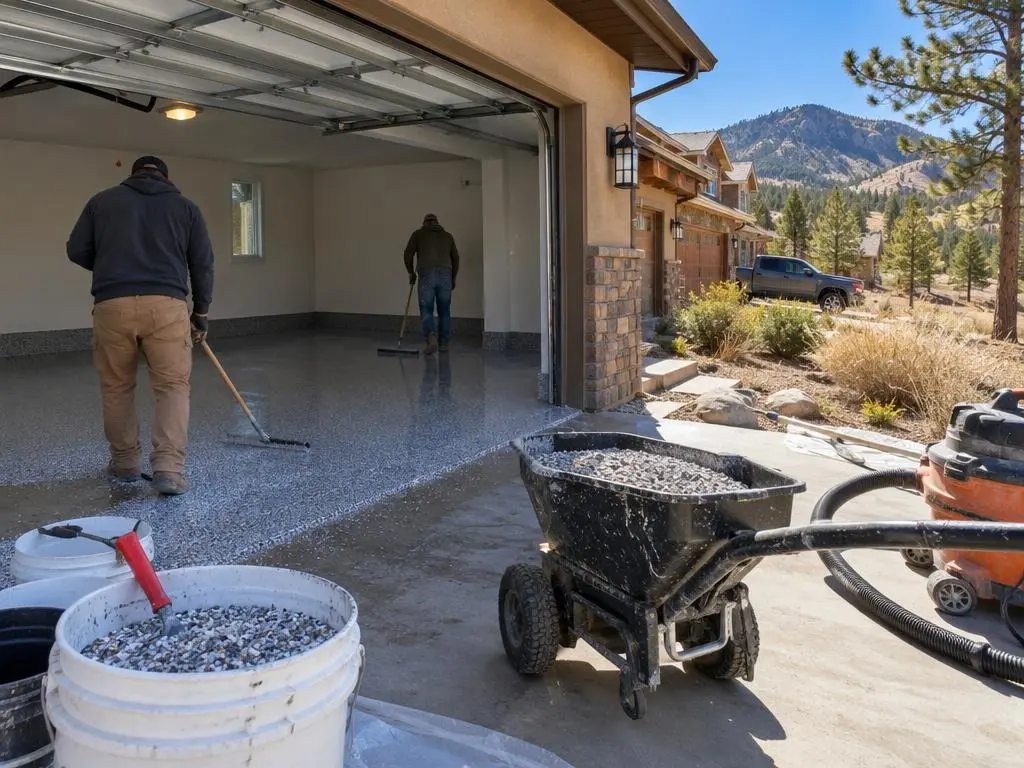
Common Questions
What is the best garage floor coating in Colorado?
For most Front Range garages, a full-broadcast flake system with a polyaspartic topcoat is the best balance of durability, grip and appearance. It resists magnesium chloride brine, hot-tire pickup and UV yellowing better than a plain epoxy topcoat, and the flakes hide minor slab flaws. Metallic epoxy looks more dramatic but shows scratches more.
How much does epoxy flooring cost in Boulder?
National cost guides put professionally installed epoxy at roughly $3 to $12 per square foot, with metallic systems around $5 to $12 and polyaspartic around $4 to $9. One guide puts a 500-square-foot two-car garage at about $1,500 to $6,000. Local prices can differ from national averages, and crack repair, old-coating removal or a moisture primer add to it. We give a written price after seeing the floor.
How much epoxy do I need for 1,000 square feet?
It depends on the system and film thickness. A thin roll-on coat covers far more area per gallon than a full-broadcast flake system with a thick base and topcoat. For a professional install, the quote covers all material, so you do not need to calculate gallons yourself.
What are the disadvantages of epoxy flooring?
Epoxy can turn slippery when wet unless grit or flakes are added, standard epoxy topcoats can yellow in strong sun, and any coating will lift if the slab has a moisture problem. Each has a fix: textured or flake finishes, UV-stable polyaspartic topcoats and moisture testing before the job.
How long does an epoxy floor last?
Published estimates for professionally installed garage coatings range widely, from about 5 to 20 years, depending on the system, the prep and how the floor is used. Thin do-it-yourself kits often fail within a few years because they are rolled onto unground concrete. Refreshing the topcoat every several years extends the life of the floor.
Can you coat a garage floor with cracks from swelling soil?
Usually, yes. Most cracks are stable and can be chased, filled and ground flush before coating, and a flake finish hides hairlines well. If one side of a crack sits noticeably higher than the other or the slab is still moving, that points to a soil or structural issue that should be addressed first.
Do I need to empty my garage before the install?
Yes. The floor has to be completely clear for grinding and coating, including shelving that sits on the slab if you want the coating underneath it. Wall-mounted storage and ceiling racks can usually stay. Plan to keep things out until the floor is cured, which we confirm for your system.
Why Homeowners Call Epoxy Flooring Boulder
Diamond grinding on every job
Acid etching and a quick sweep are not enough. Grinding opens the concrete so the coating bonds into it, not just onto it.
Moisture and movement checked first
We test the slab for moisture and look for signs of swelling-soil movement before recommending a system, and we tell you if either rules out a coating.
Topcoats chosen for altitude
UV-stable polyaspartic finishes resist the yellowing that strong Front Range sun causes in standard epoxy topcoats.
One written price
Your quote lists the prep, crack repair, coats and topcoat. Nothing is added without your written approval.
Where We Work
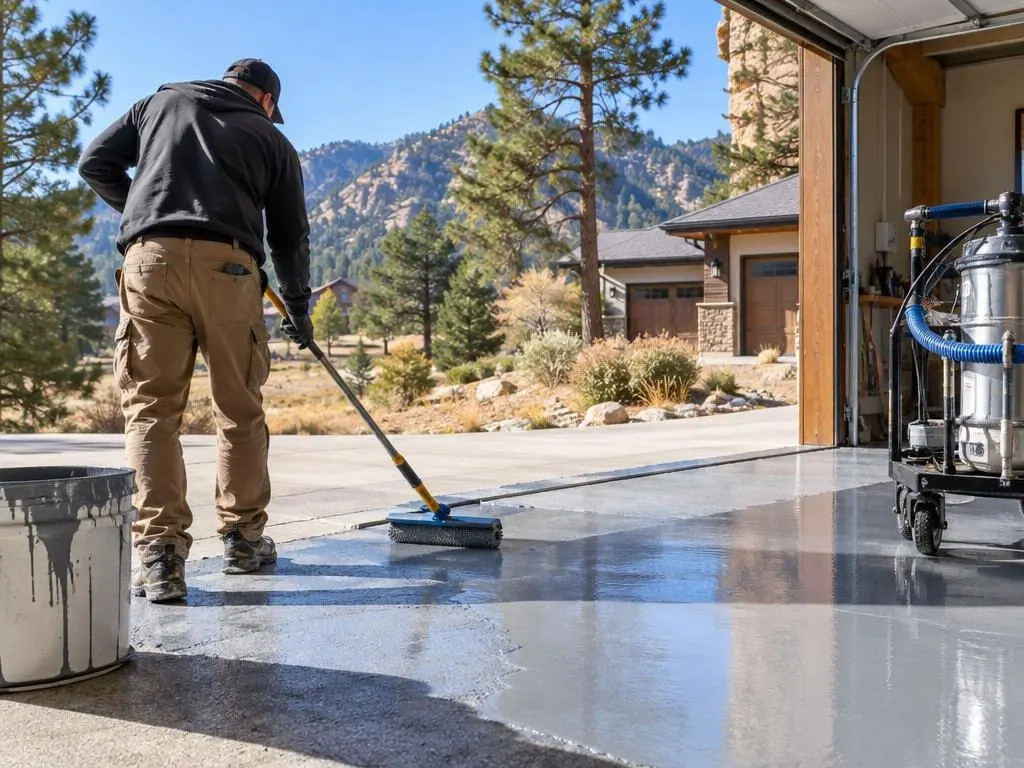
Boulder is home base. From there we serve 29 more communities across Boulder County and the northern Front Range: the east county towns of Longmont, Louisville, Lafayette, Superior, Erie, Niwot, Gunbarrel and Hygiene; the foothill and mountain communities of Lyons, Nederland, Jamestown, Eldorado Springs and Estes Park; the northern and western Denver suburbs of Broomfield, Westminster, Arvada, Wheat Ridge, Golden, Federal Heights, Northglenn and Thornton; and the growing towns to the northeast and north, including Brighton, Dacono, Frederick, Firestone, Mead, Berthoud, Johnstown and Loveland. Each area page covers what is specific to floors there, from older slabs in historic mining and farm towns to brand-new homes rebuilt after the Marshall Fire.
- Epoxy Flooring in Boulder, CO
- Epoxy Flooring in Longmont, CO
- Epoxy Flooring in Niwot, CO
- Epoxy Flooring in Gunbarrel, CO
- Epoxy Flooring in Hygiene, CO
- Epoxy Flooring in Lyons, CO
- Epoxy Flooring in Louisville, CO
- Epoxy Flooring in Superior, CO
- Epoxy Flooring in Lafayette, CO
- Epoxy Flooring in Erie, CO
- Epoxy Flooring in Broomfield, CO
- Epoxy Flooring in Nederland, CO
- Epoxy Flooring in Jamestown, CO
- Epoxy Flooring in Eldorado Springs, CO
- Epoxy Flooring in Estes Park, CO
- Epoxy Flooring in Golden, CO
- Epoxy Flooring in Westminster, CO
- Epoxy Flooring in Arvada, CO
- Epoxy Flooring in Wheat Ridge, CO
- Epoxy Flooring in Federal Heights, CO
- Epoxy Flooring in Northglenn, CO
- Epoxy Flooring in Thornton, CO
- Epoxy Flooring in Brighton, CO
- Epoxy Flooring in Dacono, CO
- Epoxy Flooring in Frederick, CO
- Epoxy Flooring in Firestone, CO
- Epoxy Flooring in Mead, CO
- Epoxy Flooring in Berthoud, CO
- Epoxy Flooring in Loveland, CO
- Epoxy Flooring in Johnstown, CO
Get an Epoxy Flooring Estimate
Free on-site estimates in Boulder and across the northern Front Range.